

There is a moment I still remember vividly.
It happened during one of my son’s school fun runs. A senior citizen overtook me with surprising ease. I remember watching him steadily pull away while I struggled to keep pace.
At first, I dismissed it as an isolated experience.
Then it happened again during another school fun run.
The second time removed every excuse I had been telling myself. I could no longer blame the weather, the route, or an unusually good performance on his part. I had to accept a far simpler explanation.
I simply was not as physically capable as I believed.
That realization was humbling.
Many people assume that losing confidence is always a negative experience. I have gradually come to believe the opposite. Sometimes confidence needs to be challenged before genuine improvement can begin.
As long as we continue believing we are performing well enough, we rarely feel any urgency to change. Reality often becomes the most honest feedback we will ever receive.
Looking back, I am grateful that those two races happened.
Not because I enjoyed losing.
Not because I enjoyed being overtaken.
But because they forced me to confront a weakness I had ignored for far too long.
That experience eventually led me to discover Spartan races.
People occasionally ask why I keep signing up for trail runs and obstacle course races.
The answer surprises them.
I do not participate primarily for entertainment. I treat every Spartan race as mental toughness training. The obstacles, the hills, the mud, and the physical exhaustion are merely the environment. The real challenge is learning to continue moving forward when every part of your body begins suggesting that you should stop.
That lesson extends far beyond running.
Life rarely asks whether we feel comfortable before presenting us with difficult problems. Businesses encounter setbacks. Investments decline. Software fails unexpectedly. Farms suffer disease outbreaks. Law school demands discipline long after motivation disappears.
Every field eventually rewards the people who continue moving after discomfort begins.
Running simply allows me to practice that response repeatedly.
After those school fun runs, I began running consistently.
Week after week, month after month, the distance gradually increased. Eventually, I found myself covering roughly 150 to 300 kilometers each month.
I never set out to become a professional athlete.
That was never the objective.
The objective was to become physically and mentally stronger than the person who had struggled during those fun runs.
One lesson has become increasingly clear throughout that journey.
Progress is rarely dramatic.
Social media often celebrates breakthroughs, championships, and extraordinary transformations. Real improvement usually looks far less exciting. It consists of ordinary days repeated consistently over long periods.
One run.
Then another.
One uncomfortable morning.
Then another.
One small improvement that seems almost insignificant by itself.
Over time, those small improvements accumulate into meaningful change.
That is exactly what happened to me.
In my second-to-the-last 10-kilometer trail run, I finished within the top 47 percent overall.
Yesterday, I finished within the top 34 percent.
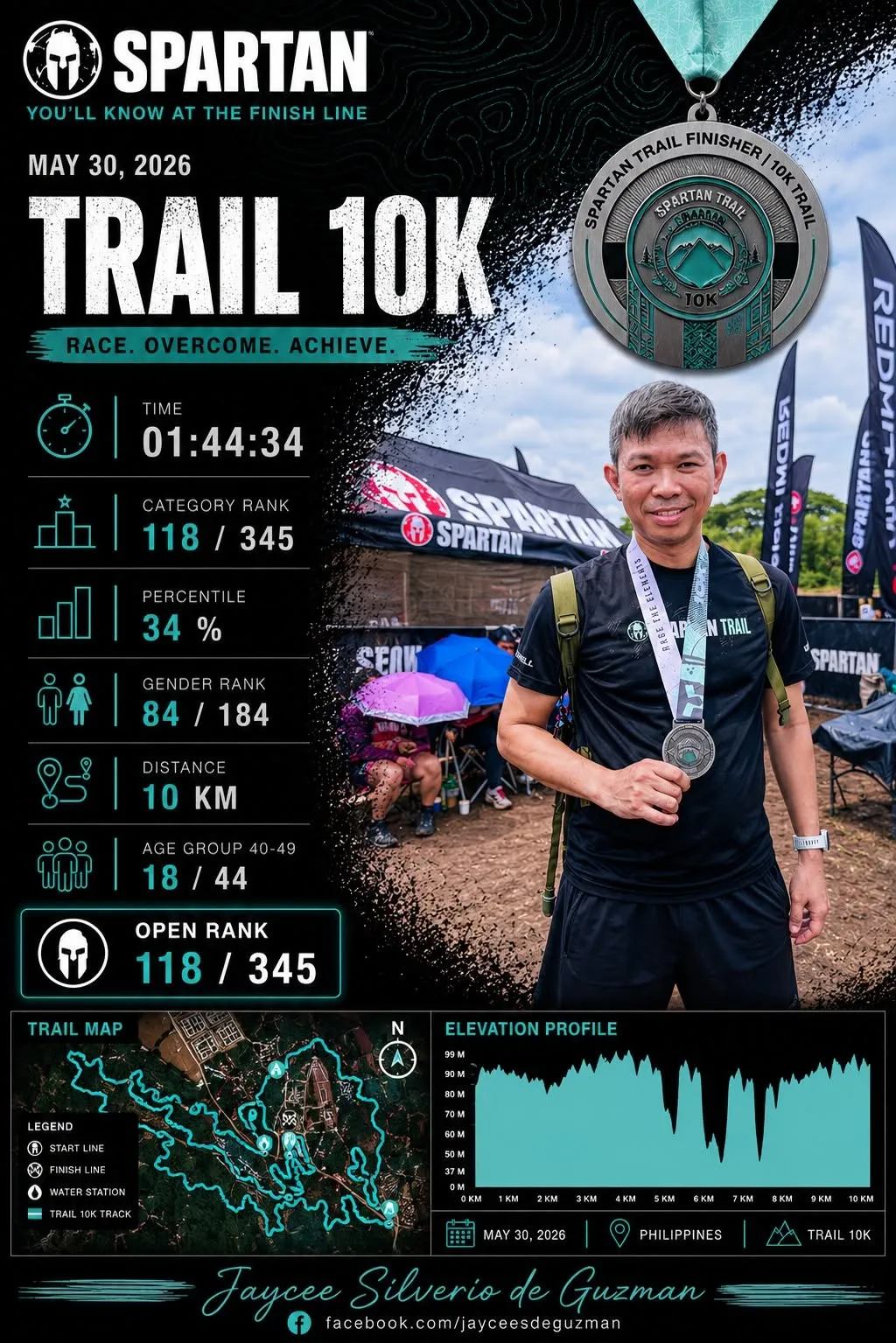
Objectively speaking, neither result is extraordinary. I still have considerable room for improvement. Yet those numbers represent something more important than rankings.
They represent evidence that consistent effort works.
If my law school schedule permits, my next goal is to break into the top 20 percent within the next three months.
Will I achieve it?
Perhaps.
Perhaps not.
Either outcome is acceptable because the ranking itself is not the real objective.
The real objective is becoming someone capable of pursuing difficult goals with consistency instead of relying on occasional bursts of motivation.
That, I believe, is the lesson many people overlook about losing.
Losing itself is neither admirable nor shameful.
It is simply information.
It reveals where we currently stand.
What matters far more is what happens afterward.
Some people protect their pride by explaining away defeat. Others quietly allow defeat to become a teacher.
The race itself lasts only a short while.
The decision that follows can influence the years that come afterward.
That is why I have come to believe that what you do after losing matters far more than losing itself.